Funktionale Sicherheit
Functional safety for rail vehicles
Safety-related risks are constantly increasing in the rail sector. This is due to the growing complexity of modern rail systems, in which hardware and software are closely interlinked and components often come from different sources. The assessment and testing of functional safety aims to minimize the risks and effects that can arise from the faulty behaviour of technical systems.
Why functional safety is crucial for you
Protection of people, systems and the environment
By systematically identifying and safeguarding safety-critical functions, we ensure that your employees, passengers and systems are protected at all times. Implementing functional safety reduces risks at an early stage and increases the operational safety of your rail vehicles.
Standards & approval security
With our expertise, you can ensure compliance with international standards such as the CENELEC EN 5012X series of standards (EN 50126, EN 50129) and their IEC equivalents – including verification for approvals and audits.
Liability & risk minimization
Verifiable safety processes help you to reduce legal and economic risks. Documented safety measures and SIL-compliant verification protect you against potential liability cases.
More efficient project and product development
Clear safety requirements and structured safety processes enable time and cost-efficient development processes – from planning to commissioning. This allows projects along the safety lifecycle to be implemented more quickly without compromising on safety.
Our services at a glance
We support your rail projects along the entire safety lifecycle – from risk assessment and SIL classification to the development of safety-critical systems and standard-compliant verification. Our experts support operators, manufacturers and workshops in the project to implement safety requirements efficiently and in compliance with regulations.
With our in-depth understanding of the EN 5012X series of standards (EN 50126, EN 50129) and the new EN 50716, we ensure that your rail vehicles and rail systems meet the highest safety standards and that you cover all regulatory requirements.
Talk to us!
We advise you on functional safety in your specific project.
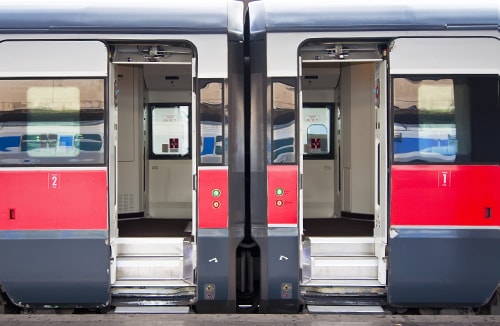
Currently, there are more and more electrical or electronic devices and systems in all areas of life that could malfunction due to various factors such as hardware or software errors, human error, environmental influences such as temperature or wind and thus cause damage to living beings or the environment if they did not contain safety mechanisms that take precisely these factors into account. An example from the rail sector is the passenger door of a rail vehicle: it must be ensured, for example, that the door
- only opens when the vehicle is stationary,
- does not close while people are still boarding,
- is closed before the train departs,
- does not open while driving.
Functional safety is part of the overall system. The IEC (International Electrotechnical Commission) has described the basic complete life cycle of safety-related systems in the IEC 61508 standard. IEC 61508 is used for the development of
- electrical systems
- electronic systems and
- programmable electronic systems.
These systems (E/E/PE) are divided into 4 (actually 5) requirement or risk classes (Safety Integrity Levels, SIL for short) in terms of their hazard potential.
IEC 61508 has enabled the creation of product- and application-specific international standards that deal with safety-related E/E/PE systems, examples of which can be found here.
Hazards can be identified on the basis of a risk analysis, which are resolved in the form of safety certificates. Risks that cannot be dealt with any further are included in the verification chain as residual risks. One motivation for verifying functional safety may be legal requirements in order to bring a product onto the market, or the manufacturer’s product liability.
The implementation of IEC 61508 for companies, their products and processes is highly complex. Numerous work steps are required, from the inventory, analysis, documentation, development of a safety plan, its realization, communication and implementation through to validation.

Safety Compliance
Unser Team hilft ihnen ihre Produkte den Normen anzupassen und Prozesse zu verbessern.
Mehr…

Safety Engineering
Wir führen Sie durch die komplexen Systeme und stehen Ihnen als Safety-Engineers zur Seite.
Mehr…

Safety Management
Unser Safety Management orientiert sich immer an den Anforderungen des Marktes.
Mehr…
Funktionale Sicherheit
Wir implementieren Sicherheitsmechanismen für alle erdenklichen Fälle in einem System.
Mehr…

Funktionaler Nachweis
Nachweise durch den Einsatz unserer Software Meet the Standard effizienter erstellen.
Mehr…